GPON Networking: From OLT to Customer
The problem most internet service providers (ISPs) face when bringing a network to thousands of customers is building one that is both scalable and cost-effective.
If a dedicated fiber cable ran directly from the ISP’s network to every home, it would require a huge amount of fiber, ports, and equipment. And as the number of customers grows, so does the infrastructure needed to support them.
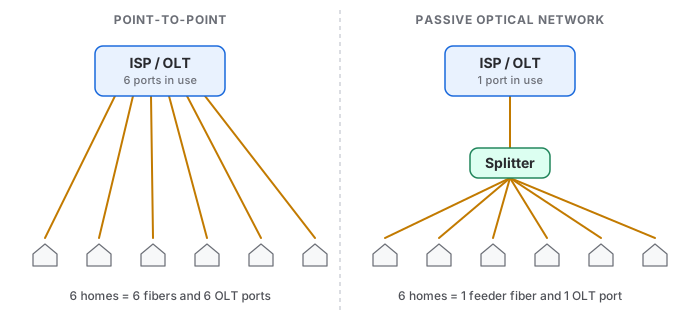
Gigabit-capable Passive Optical Network (GPON), defined in the ITU-T G.984 standard, solves this problem by allowing a single fiber from an Optical Line Terminal (OLT) to be shared among many customers. This is done using passive optical splitters: simple, unpowered devices that divide one fiber signal so it can serve multiple homes, removing the need for a dedicated fiber to each one.
This makes GPON a cost-effective and scalable way of deploying fiber to the home (FTTH).
GPON Architecture
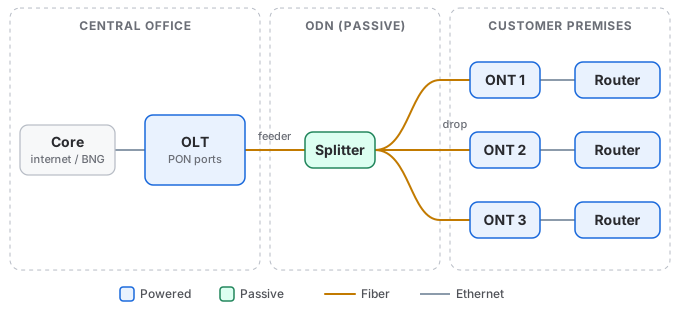
A GPON network is built from four main parts:
- OLT – the equipment at the ISP that controls the network
- ODN – the fiber, boxes and splitters between the ISP and the customer
- Splitter – the passive device that shares one fiber between many homes
- ONT – the device at the customer’s home
This is a simplified view of how they fit together:
1. OLT – Optical Line Terminal
The OLT is the central point of an ISP’s passive optical network (PON). A PON is a fiber optic setup that uses unpowered optical splitters to share a single fiber strand between multiple users.
The OLT sits on the ISP side of the network and acts as the connection between the ISP’s core network and the PON. It communicates with multiple Optical Network Terminals (ONTs), located at the customers’ premises, through the optical distribution network.
An OLT typically has multiple PON ports. Each PON port connects to a single fiber strand, called the feeder fiber, which then runs to a passive optical splitter. Depending on the OLT and the network design, a single PON port can support dozens of ONTs, commonly up to 64 or 128.
Each GPON port provides 2.488 Gbps downstream and 1.244 Gbps upstream, and that capacity is shared by every ONT on the port. This works because customers rarely all use their full speed at the same time.
Since the fiber and splitters are passive, the OLT is also the “brain” of the whole PON. It is responsible for:
- Discovering and registering new ONTs
- Deciding when each ONT is allowed to send data upstream
- Applying VLANs and bandwidth profiles for each customer
- Monitoring the optical signal levels of every ONT
2. ODN – Optical Distribution Network
The ODN is everything between the OLT and the ONT: the fiber cables, distribution boxes, splitters, connectors and splices. None of it needs power.
In most networks, each PON port feeds a main distribution box. For example, if an OLT has 8 PON ports, there could in theory be 8 main distribution points. From each main distribution point, the fiber is distributed towards different areas and eventually to individual customers.
An ISP may have several main distribution points serving different areas. Each main distribution point can then feed multiple sub-distribution points that bring the fiber closer to the customers.
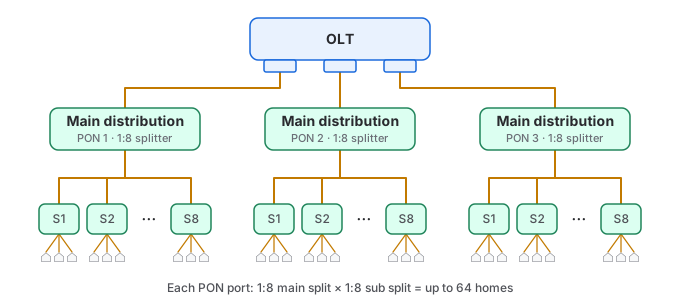
The image above shows an example of an OLT with three PON ports, with each PON port going to its own main distribution box. Each main distribution box has a 1:8 splitter that feeds up to 8 sub-distribution boxes, and each sub-distribution box has another 1:8 splitter that feeds up to 8 homes. That gives 8 × 8 = 64 customers on a single PON port.
This is called cascaded splitting, because the signal is split in more than one stage. The other option is centralized splitting, where a single 1:32 or 1:64 splitter sits in one cabinet and every home gets its own fiber from there. Cascaded splitting uses less fiber, while centralized splitting is easier to troubleshoot and upgrade.
Either way, this allows the ISP to extend the fiber network across a large geographical area without having to run a direct fiber from the OLT to every customer.
3. Splitter
The splitter is one of the most important components of a passive optical network. It allows a single fiber connection to be divided into multiple paths, so multiple customers can share the same PON port on the OLT.
Unlike a switch, which is an active network device, the splitter is a passive device that does not require any power to operate. Its only task is to divide the light between its output ports. It also works in the other direction, combining the light coming back from each home onto the single feeder fiber.
For example, a 1:8 splitter takes 1 input and divides the optical signal between 8 output fibers. Each output only gets one eighth of the light:
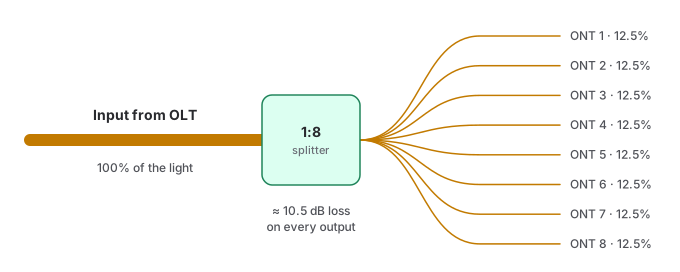
The same applies to split ratios of 1:2, 1:4, 1:16, 1:32 and 1:64. The split ratio used depends on the ISP’s network design and the optical budget.
As the signal is split between more outputs, each output receives less light, which means more optical loss. Every time the signal is split in two, roughly half the power goes each way, which is about 3 dB of loss plus a little extra from the splitter itself:
| Split ratio | Typical loss |
|---|---|
| 1:2 | 4.0 dB |
| 1:4 | 7.3 dB |
| 1:8 | 10.5 dB |
| 1:16 | 13.7 dB |
| 1:32 | 17.1 dB |
| 1:64 | 20.5 dB |
This is why the number of times a fiber can be split is limited by the optical budget, which is covered further below.
4. ONT – Optical Network Terminal
The ONT is located at the customer’s premises and provides the optical-to-Ethernet interface between the PON and the customer’s local network. In simple terms, the ONT converts the optical signal received over the fiber into an Ethernet connection that the customer’s router can use. Some devices combine the ONT and router in one box and also provide Wi-Fi. You may also see an ONT called an ONU (Optical Network Unit); in practice the two terms mean the same thing.
Every ONT has a unique serial number, similar to a MAC address. When a new ONT is plugged in, the process looks like this:
- The ONT receives light from the OLT and syncs to it.
- The OLT discovers the ONT and reads its serial number.
- The ISP authorizes the ONT, usually by matching the serial number (or a password) to the customer’s account.
- The OLT assigns the ONT an ID on that PON port and measures how far away it is.
- The OLT pushes the configuration to the ONT, such as VLANs, internet service, and voice lines, using a management channel called OMCI.
Once this is done, the ONT is online and the customer has internet.
How Data Travels Over a Shared Fiber
If every ONT shares the same fiber, how does the data for one customer not get mixed up with another’s? GPON solves this in two ways.
First, the two directions use different wavelengths (colors) of light on the same fiber strand. Downstream traffic from the OLT uses 1490 nm, and upstream traffic from the ONTs uses 1310 nm, so the two directions never interfere with each other. Some ISPs also use 1550 nm to deliver TV.
Second, each direction shares the fiber in a different way:
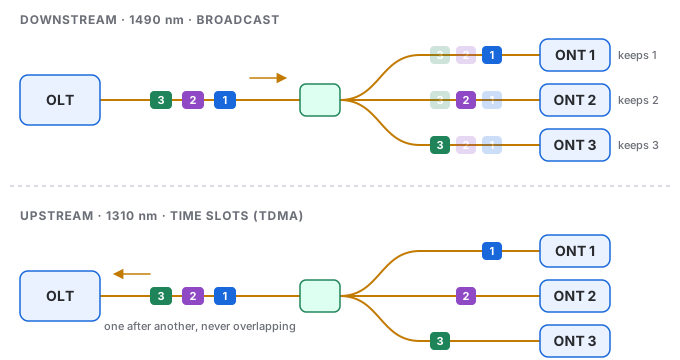
Downstream (broadcast): The OLT sends every frame to every ONT on the PON port, because the splitter copies the light to all outputs. Each ONT only keeps the frames addressed to it and ignores the rest. Downstream traffic is also encrypted with AES, so a customer cannot read their neighbor’s data.
Upstream (time slots): If all the ONTs sent data at the same time, their signals would collide in the splitter. To avoid this, the OLT gives each ONT its own time slot to send in, which is called Time Division Multiple Access (TDMA). The OLT adjusts these slots based on how much data each ONT needs to send, which is known as Dynamic Bandwidth Allocation (DBA).
This is also why the OLT measures the distance to each ONT during registration. A home 1 km away and a home 15 km away will have their signals arrive at different times, so the OLT compensates for the delay to make sure the time slots line up perfectly.
Optical Budget
The optical budget is the maximum amount of loss allowed between the OLT and the ONT while the signal is still readable. Every splitter, kilometer of fiber, connector and splice takes a little bit of it away.
Most GPON networks use Class B+ optics, which have a budget of 28 dB. There is also Class C+, with a budget of 32 dB, for longer distances or higher split ratios.
As an example, this is the budget for a customer at the end of the network from the ODN section, with a 1:8 splitter at the main distribution box and another at the sub-distribution box, 5 km from the OLT. The fiber loses about 0.35 dB per km (5 × 0.35 = 1.75 dB), each of the 4 connectors about 0.3 dB, and each of the 6 splices about 0.1 dB:
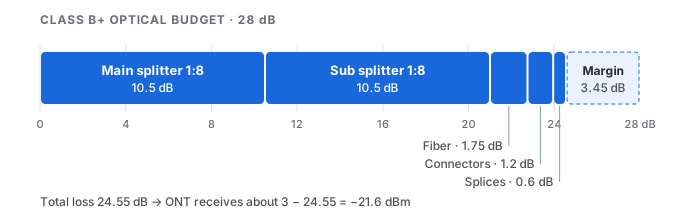
That leaves 3.45 dB of margin, which is important because fiber gets repaired, connectors get dirty, and extra splices get added over time. If the OLT sends at +3 dBm, the ONT will receive about −21.6 dBm. A Class B+ ONT can usually work down to around −27 dBm, but ISPs normally aim for a signal between −15 and −25 dBm.
The splitters take up most of the budget. If the same network used a 1:16 splitter at both stages, the splitters alone would cost 27.4 dB, leaving almost nothing for the fiber. This is why a single PON port is usually limited to 64 or 128 customers.
Putting It All Together
To tie everything together, this is what happens when a customer opens a website:
- The customer’s device sends the request to their router, which passes it to the ONT over Ethernet.
- The ONT waits for its time slot, then sends the request as 1310 nm light over its drop fiber.
- The light passes through the sub-distribution splitter and the main distribution splitter, where it joins the other customers’ traffic on the feeder fiber.
- The OLT receives it on the PON port and sends it into the ISP’s core network and out to the internet.
- The reply comes back to the OLT, which sends it downstream as 1490 nm light.
- The splitters copy the light to every home on that PON port, but only this customer’s ONT decrypts it and passes it to the router.
All of this happens without a single powered device between the ISP and the customer’s home. That is what makes GPON so cost-effective: one OLT port, one feeder fiber and a few passive splitters can bring fiber internet to dozens of homes.